
Solid Shampoo, Shampoo Bar or Hair Soap: What’s the Difference?

A practical guide to product names, cleansing systems & ingredient lists
A solid hair cleanser may look like soap without using a traditional soap formula. Two products with a similar shape may also rely on completely different cleansing systems.
The name on the packaging is therefore only the starting point. To understand what a product really is, look at its main cleansing ingredients and complete ingredient list.

Same shape. Different cleansing system.
At a glance
Different names may describe the same type of solid hair cleanser.
Similar looking bars may use different cleansing systems.
The complete ingredient list tells you more than the shape alone.
The words Solid, Bar or Soap do not confirm the formula by themselves.
In this guide
1. What do the different names mean?
Common English names include:
Solid Shampoo
Shampoo Bar
Hair Soap
Shampoo Soap
Soap Based Shampoo
Solid generally describes the physical form of the product.
Bar usually describes its shape.
Soap may suggest a traditional soap formula, but the word is also used for solid cleansers made with other cleansing ingredients.
Traditional Chinese terminology also varies by region.
In Hong Kong, regular shampoo is commonly called shampoo (洗頭水). The term shampoo (洗髮露) also appears in product names and formal consumer information.⁴ ⁵
For solid products, common Hong Kong terms include:
Solid shampoo or shampoo bar (洗頭梘)
Hair soap or shampoo soap (洗頭皂)
In Taiwan, common terms include:
Shampoo bar (洗髮餅)
Shampoo soap (洗髮皂)
Taiwan’s Food and Drug Administration also uses (洗髮餅) and (洗髮皂) when explaining two different formulation approaches.²

These names broadly overlap, but they are not exact technical definitions. Regional language, product positioning and market habits can all affect the name used.
Different names may still describe a similar product format, but the name does not always reveal the formula.
2. Is a solid bar always traditional soap?
No.
Traditional soap is generally made by combining fats or oils with an alkali. This reaction produces alkali salts of fatty acids, which provide the cleansing action.
Under the regulatory definition used by the United States Food and Drug Administration, a product is considered soap when it is mainly composed of alkali salts of fatty acids and those ingredients provide its cleansing action.¹
The FDA also explains that many solid cleansers sold under the name Soap use surfactant based cleansing systems instead. The word Soap may still appear on the label even when the product does not meet the FDA’s regulatory definition of traditional soap.¹
This is a United States regulatory definition rather than a universal naming rule. However, it clearly shows why product shape and product name cannot confirm the formula by themselves.
A solid bar can be traditional soap, a solid surfactant cleanser or a combination of both systems.
3. What are the two main cleansing systems?
Solid hair cleansers generally follow two main formulation approaches.
Traditional soap cleansing system
Fats or oils react with an alkali to form soap salts. Ingredient names such as Sodium Olivate, Potassium Olivate or Sodium Cocoate may indicate this type of system.
Solid surfactant cleansing system
Surfactants are combined with supporting ingredients and manufactured into a concentrated solid format. These products may look like soap but use a cleansing system closer to modern shampoo.
Taiwan’s Food and Drug Administration makes a similar distinction in its educational guidance:
Shampoo Soap (洗髮皂) is made with oils and soap alkali.
Shampoo Bar (洗髮餅) is based on solid surfactants.
Regular Shampoo (洗頭水) mainly uses a surfactant based formula.²

Some formulas may also combine soap salts with other surfactants.
Different systems use different formulation approaches. Neither is automatically better.
4. What is a surfactant?
A surfactant is a cleansing ingredient that helps water interact with sebum, oil, dirt and product residue.
One part of a surfactant interacts with oily material, while another part interacts with water. This helps unwanted residue disperse in water and rinse away.
Modern cleansers may combine several surfactants to achieve a particular balance of cleansing, foam and hair feel. The complete formula may also contain conditioning agents, fatty alcohols, glycerin, plant oils or other supporting ingredients.³
Surfactant is a technical description of how an ingredient functions. It does not automatically mean that a product is unsafe, low quality or unsuitable for hair.
5. Does more foam mean better cleansing?
Not necessarily.
Foam can help distribute a cleanser across the scalp and hair, but foam volume is not a direct measurement of cleansing performance.³
The Hong Kong Consumer Council also states that the amount of shampoo foam does not necessarily have a direct relationship with cleansing effectiveness.⁴

Foam may also vary according to the formula, the amount of oil or residue on the hair, the water used and the application method.
More foam does not automatically mean better cleansing. Less foam does not mean that a product has no cleansing ability.
6. How can you read the ingredient list?
Under relevant European labeling rules, products must provide an ingredient list using recognized ingredient names. Ingredients are generally listed in descending order by weight when added to the formula, while ingredients below 1 percent may be listed in any order after those present above 1 percent.⁶
This is why ingredient lists use technical names rather than everyday descriptions.
Ingredients that may suggest a traditional soap system
Sodium Olivate
Potassium Olivate
Sodium Cocoate
Sodium Palmate
These names generally refer to alkali salts made from fatty acids.
Ingredients that may appear in solid surfactant formulas
Sodium Coco Sulfate
Sodium Cocoyl Isethionate
Sodium Lauroyl Methyl Isethionate
Cocamidopropyl Betaine
Coco Glucoside
A formula may use one main surfactant or combine several cleansing ingredients.
It may also contain:
Glycerin
Fatty alcohols
Plant oils
Plant butters
Proteins
Conditioning ingredients
Fragrance and supporting ingredients
These supporting ingredients may influence texture, foam, detangling, conditioning support and overall hair feel.
Mixed cleansing systems
Some products contain both soap salts and other surfactants.
For example:
Sodium Olivate or Sodium Cocoate may suggest soap based cleansing.
Sodium Coco Sulfate belongs to a sulfate surfactant system.
Sodium Cocoyl Isethionate belongs to a different surfactant family.
Several cleansing ingredients together may indicate a blended system.

These examples only help identify the general direction of a formula. They do not prove that one system is automatically safer, gentler or better than another.
Turn the packaging around. The ingredient list usually tells you more than the front label.
Natural origin, organic content, independent certification and Sulfate Free claims are separate from the type of cleansing system. They cannot be confirmed from the product shape or one ingredient name alone.
These subjects will be explained separately in EHD’s guide to natural origin, Sulfate Free & product claims.
7. Can one ingredient explain the complete formula?
No.
The way a finished product cleanses and feels may also be influenced by:
The type and combination of cleansing ingredients
The concentration of those ingredients
Product pH
Moisturizing and conditioning ingredients
The amount used
Contact time and rinsing
Scalp and hair condition
Previous coloring or chemical treatments
A formula containing an effective cleanser may also include ingredients that support softness and help reduce a dry feel.
A product positioned around gentle cleansing may still not suit every person.
The complete formula matters more than one ingredient viewed in isolation.
8. How should you choose a solid hair cleanser?
Before choosing a solid shampoo or hair soap, consider:
Your scalp and hair condition
Your preferred level of cleansing
The main cleansing ingredients
Whether the formula contains conditioning or moisturizing ingredients
Whether your hair is colored or chemically processed
Whether you normally use conditioner or a hair mask
The official usage and storage instructions
There is no single cleansing system that is automatically suitable for everyone.
The product name can help you begin your search. Its complete ingredient list, intended use and verified product information provide a clearer picture of what it may offer.
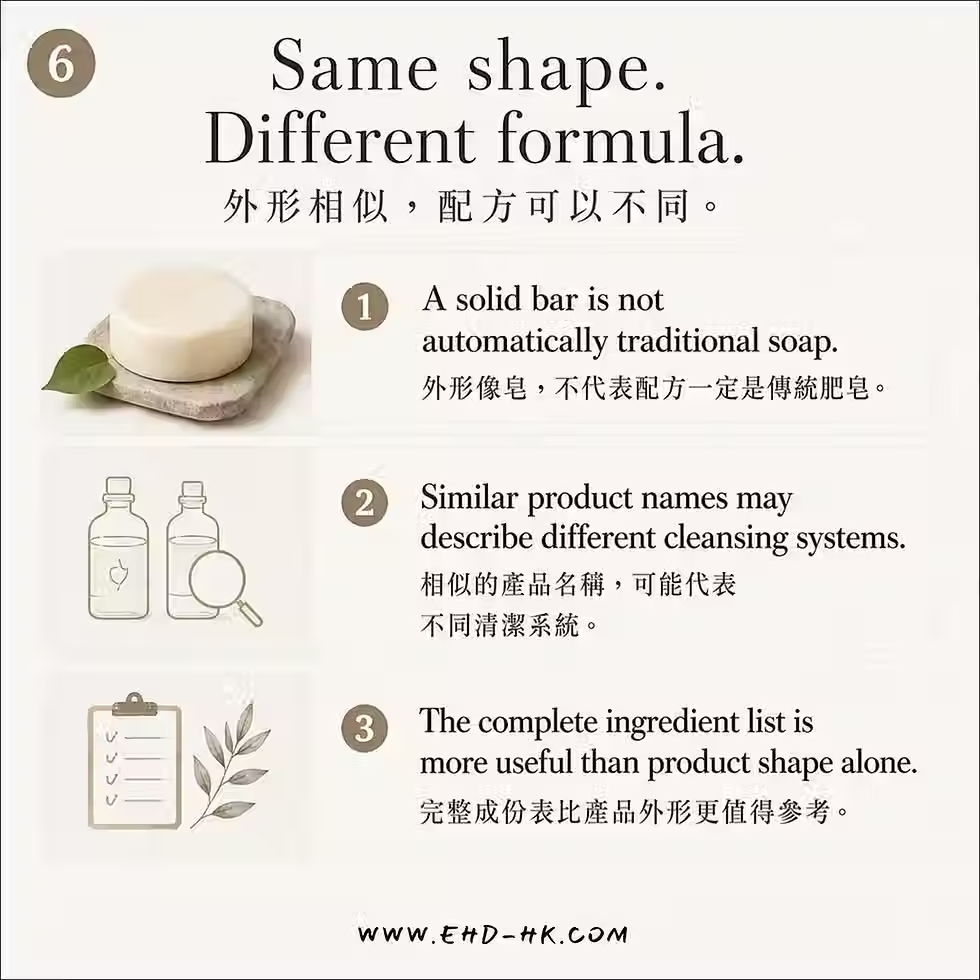
Three points worth remembering
A solid bar is not automatically traditional soap.
Similar product names may describe different cleansing systems.
The complete ingredient list is more useful than product shape alone.
Explore Solid Shampoo & Shampoo Bars
After understanding the different names and cleansing systems, browse EHD’s solid shampoo and shampoo bar selection according to your scalp, hair and cleansing needs.
Sources
United States Food and Drug Administration. Frequently Asked Questions on Soap.
Taiwan Food and Drug Administration. Drug and Food Safety Weekly, Issue 1029: What Is a Shampoo Bar and How Is It Used?, 6 June 2025.
D’Souza P, Rathi SK. Shampoo and Conditioners: What a Dermatologist Should Know? Indian Journal of Dermatology, available through PubMed Central.
Hong Kong Consumer Council. Hair Care Tips: Does More Shampoo Foam Mean Better Cleansing?
Hong Kong Department of Health, Drug Office. How to Use Head Lice Lotion.
European Union. Regulation (EC) No 1223/2009 on Cosmetic Products.
Comments